You moved to the Gulf six months ago. Everything was exciting at first. New job, new apartment, new chapter. Then you noticed it. Clumps of hair in the shower drain. More on your pillow each morning. Your ponytail feels thinner. You’re 32, healthy, not stressed, so what’s happening?
Here’s what no one told you before you relocated: the water here isn’t just different. It’s fundamentally incompatible with hair that evolved in softer water environments. And your follicles are responding exactly as they should to a chemical assault they’ve never encountered before.
This isn’t about stress or genetics or some mysterious tropical condition. It’s about water chemistry. The Gulf region has some of the hardest water on Earth, up to 400 mg/L of dissolved minerals compared to 50-100 mg/L in most Western countries. That’s not a small difference. That’s a physiological crisis your hair can’t adapt to.
This article contains affiliate links. See our affiliate disclosure for details.
The Hard Water Reality No One Warns You About
Let’s start with what you’re actually washing your hair with. In the Gulf, most water comes from desalination plants. The process removes salt but concentrates other minerals, calcium, magnesium, silicates, to levels that would be considered unsafe for industrial use in other countries. Then that water travels through aging infrastructure that adds more contaminants.
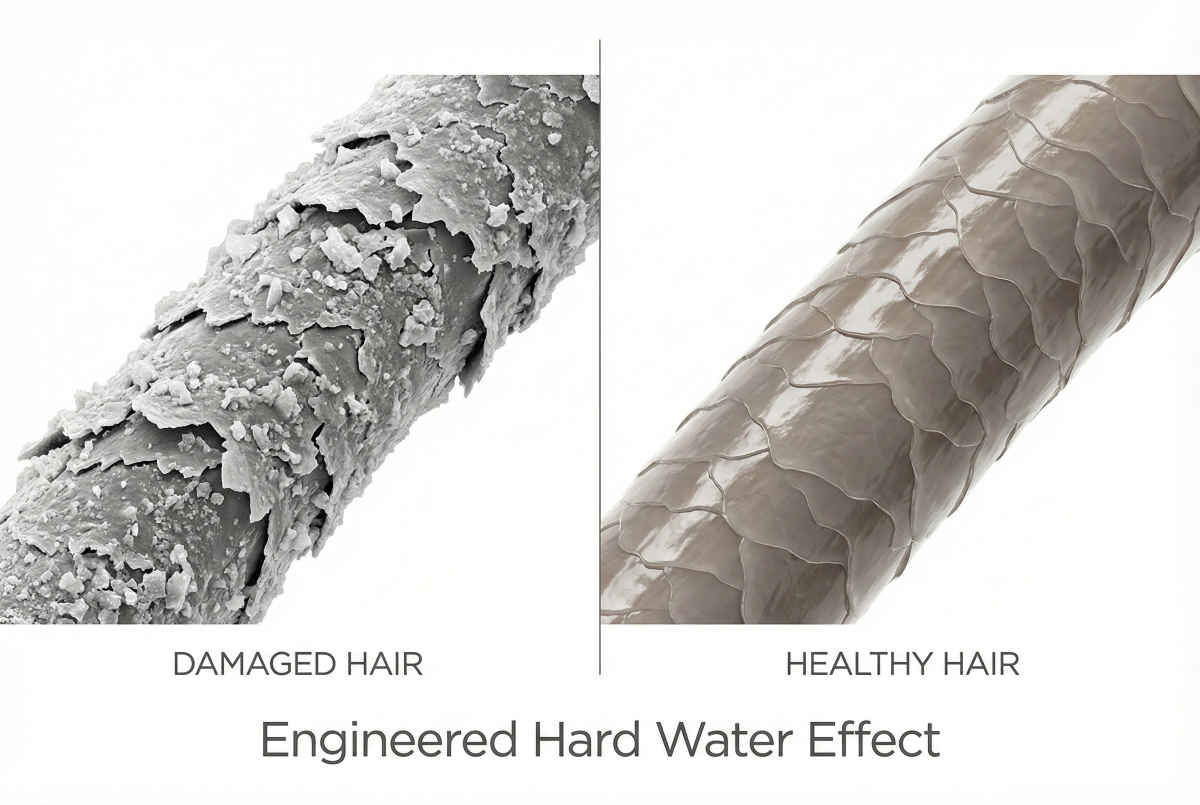
When you shower, you’re not rinsing your hair. You’re coating it. Each wash deposits a microscopically thin layer of mineral scale. After weeks, that buildup becomes visible as dullness, roughness, and brittleness. After months, it starts physically blocking your follicles.
A study published in the International Journal of Trichology found that hard water significantly increases hair porosity and surface roughness, making it more prone to breakage and tangling. But the study was conducted in areas with water hardness around 200 mg/L. The Gulf regularly exceeds 350 mg/L.
Your hair is designed to be slightly acidic (pH 4.5-5.5). Hard water in the Gulf is typically alkaline (pH 7.5-8.5). Every shower pushes your hair further from its optimal state. The cuticle scales lift. The cortex weakens. The follicle becomes inflamed. And eventually, the hair stops growing altogether.
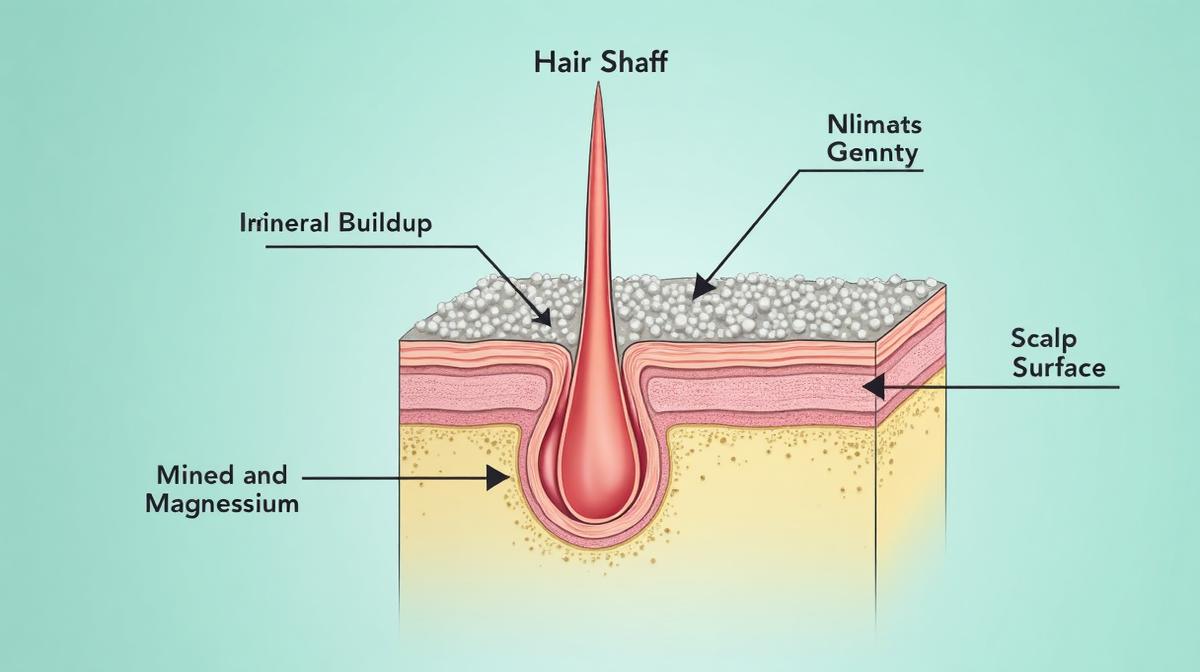
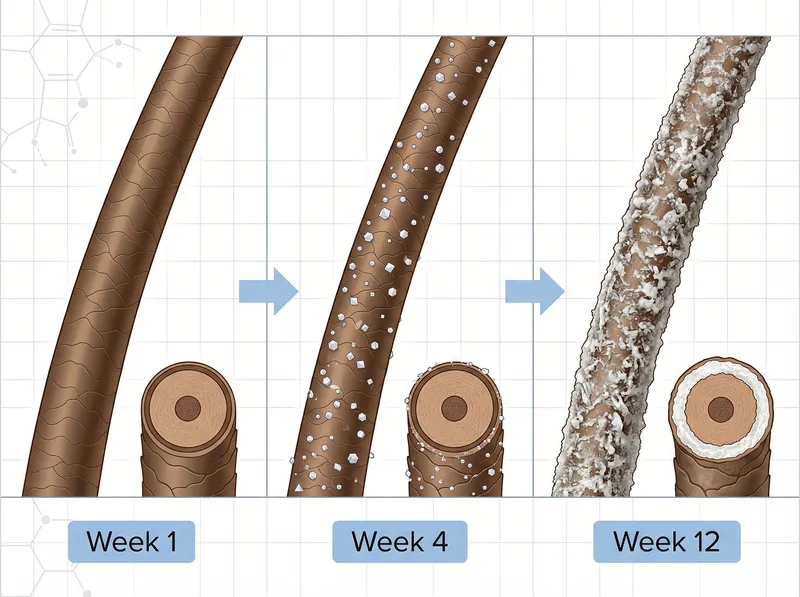 How hard water minerals coat the hair shaft and accumulate on the scalp, leading to progressive hair loss
Why Your Hair Loss Started Suddenly
You didn’t lose hair gradually. It happened all at once, about 3-6 months after you arrived. That’s not a coincidence. That’s the hair growth cycle responding to environmental shock.
Hair grows in three phases: anagen (growth), catagen (transition), and telogen (rest). When your body experiences a significant stressor, and yes, hard water is a stressor, it pushes a large percentage of follicles into telogen simultaneously. This is called telogen effluvium.
But here’s the part that makes the Gulf different: in most cases of telogen effluvium, hair regrows once the stressor is removed. When the stressor is your daily shower, it never stops. The follicles that shed don’t recover because they’re immediately exposed to the same mineral assault that triggered the shedding.
According to research from the World Health Organization, chronic exposure to hard water can lead to cumulative scalp inflammation and progressive follicle miniaturization. In plain terms: your follicles are shrinking. Each hair cycle produces a thinner, weaker strand until eventually the follicle stops producing visible hair.
This explains why some expats see temporary improvement with expensive salon treatments, only to watch the hair loss resume weeks later. You can’t treat a chronic environmental exposure with occasional interventions. You have to change the water itself.
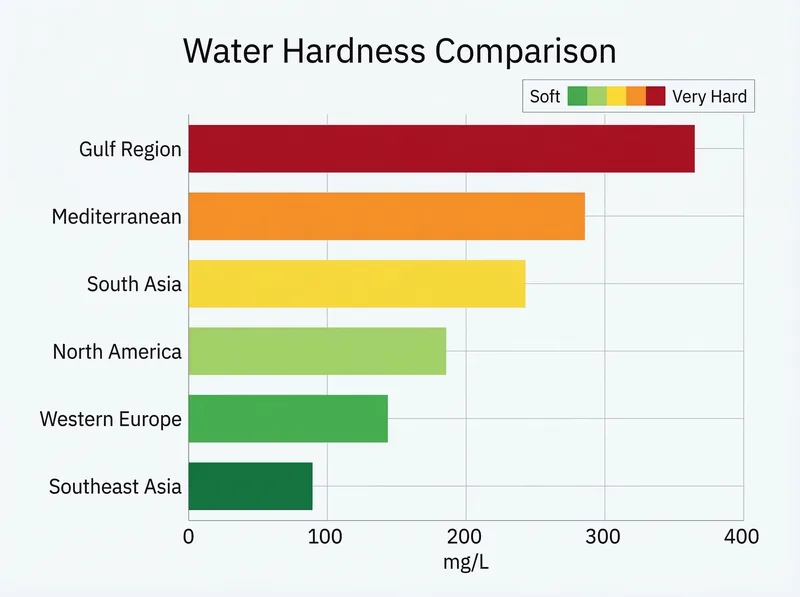 Water hardness levels in the Gulf region compared to other major cities worldwide (measured in mg/L calcium carbonate)
The Three Mechanisms of Hard Water Hair Loss
Let’s get specific about how this actually works. There are three distinct ways hard water destroys hair, and you’re probably experiencing all three simultaneously.
Mechanism 1: Physical Coating and Buildup
Calcium and magnesium ions in hard water bind to the keratin proteins in your hair shaft. This creates a rough, scaly surface that catches and tangles with other hairs. The coating is hygroscopic, it attracts moisture from the air and swells, then contracts when dry. This constant expansion and contraction weakens the hair structure.
Over time, the mineral layer becomes thick enough to see. Your hair looks dull, feels rough, and doesn’t respond to conditioning treatments because the minerals create a barrier. Products can’t penetrate. Moisture can’t enter. The hair becomes progressively more brittle.
Mechanism 2: pH Changeion and Cuticle Damage
The alkaline pH of hard water forces the hair cuticle to open. In healthy hair, the cuticle lies flat like overlapping roof shingles, protecting the inner cortex. When the cuticle is forced open, the cortex is exposed to oxidative damage, protein loss, and moisture evaporation.
A clinical study in the Journal of Cosmetic Science demonstrated that washing hair with alkaline water (pH 8.0) caused significant cuticle lifting and protein loss compared to neutral water. The damage was cumulative and irreversible without intervention.
This is why your hair feels rough even right after washing. The cuticle never closes properly. Each strand rubs against others, causing friction damage and breakage. Your brush is full of broken hairs, not shed hairs, there’s a difference.
Mechanism 3: Follicle Blockage and Inflammation
The minerals don’t just coat your hair. They accumulate on your scalp, particularly around the follicle openings. This creates a physical barrier that blocks sebum flow, traps dead skin cells, and prevents the follicle from breathing.
The blocked follicle becomes inflamed. You might notice itching, flaking, or small bumps on your scalp. This is folliculitis, inflammation of the hair follicle. Chronic inflammation triggers the follicle to enter telogen prematurely. The hair sheds before completing its growth phase.
Research published in Colloids and Surfaces B: Biointerfaces showed that calcium deposits on the scalp surface can reduce follicle oxygenation by up to 40%. Less oxygen means weaker hair production. Weaker hair means visible thinning.
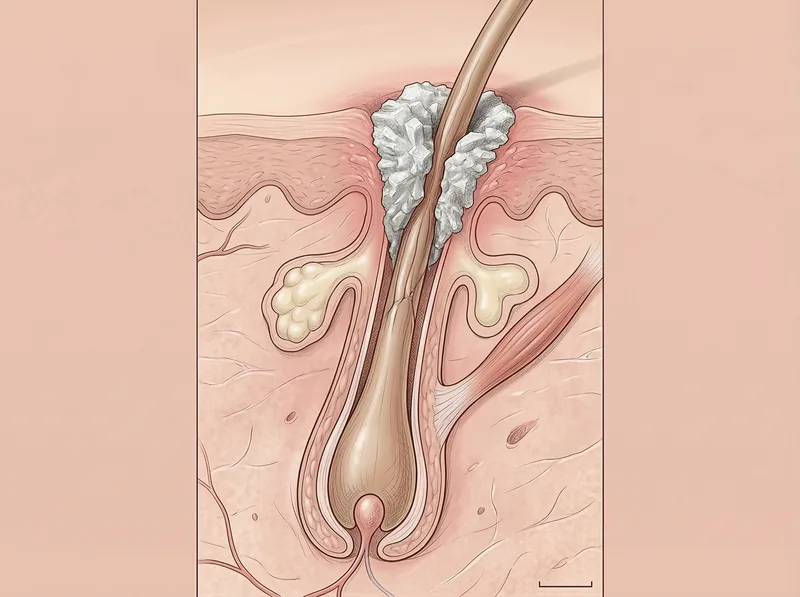 Microscopic view of how mineral buildup from hard water physically blocks the follicle opening, preventing healthy hair growth
Why Standard Solutions Don’t Work Here
You’ve probably already tried the obvious fixes. Expensive shampoos. Deep conditioning treatments. Supplements. Hair masks. And nothing worked. Here’s why.
Most hair products are formulated for soft to moderately hard water (under 150 mg/L). They’re designed to work in an environment where the water itself isn’t the problem. When you’re dealing with Gulf-level hardness, standard products can’t overcome the mineral load. They just add more buildup on top of the existing buildup.
Conditioning treatments are particularly useless. Conditioners work by depositing cationic polymers onto the hair shaft to smooth the cuticle and reduce friction. But when the hair is already coated in mineral scale, the conditioner has nothing to bind to. It just slides off, washes away, and leaves you with the same rough, damaged hair you started with.
Even clarifying shampoos, designed to remove buildup, typically can’t handle hard water minerals. They’re formulated to remove product buildup, oil, and light environmental deposits. Calcium carbonate and magnesium silicate require chelating agents specifically designed to break ionic bonds. Regular surfactants can’t do this.
This is why the standard hair fall treatments that work in other climates often fail in the Gulf. You’re not just treating hair loss. You’re treating chemically damaged hair in an environment that continues to damage it with every shower.
The Shower Filter Myth
Let’s address the most common “solution” people try: shower filters. You’ve probably seen them advertised. Some claim to remove 99% of chlorine and heavy metals. Others promise “softer water” and “healthier hair.” They don’t work. Here’s why.
Most shower filters use activated carbon or KDF media. These are excellent for removing chlorine, some heavy metals, and organic compounds. But they do almost nothing for calcium and magnesium, the primary minerals responsible for water hardness. The chemistry doesn’t work.
True water softening requires ion exchange, replacing calcium and magnesium ions with sodium ions. This needs a resin bed, regeneration with salt, and significant water pressure. Shower filters don’t have the capacity or flow rate to perform this exchange effectively. They’re too small and the water moves too fast.
A technical report from the US Environmental Protection Agency confirms that point-of-use shower filters cannot significantly reduce water hardness. They may reduce chlorine taste and odor, but the mineral content remains unchanged.
This doesn’t mean shower filters are useless. They can help with chlorine and some other contaminants. But if you’re expecting them to solve your hard water hair loss problem, you’ll be disappointed. The minerals will still be there, still coating your hair, still blocking your follicles. For a deeper analysis of why shower filters fail at mineral removal, see our article on the shower filter myth.
What Actually Works: The Chelation Solution
The only way to remove hard water minerals from hair is chelation. This is a chemical process where specific molecules bind to metal ions and allow them to be rinsed away. It’s the same process used in industrial water treatment, medical detoxification, and now, increasingly, in hair care for hard water regions.
Chelating agents work by forming stable complexes with calcium and magnesium ions. The most effective agents for hair care are EDTA (ethylenediaminetetraacetic acid), citric acid, and phytic acid. These molecules have multiple binding sites that grab onto mineral ions and hold them in solution until they’re rinsed away.
But here’s the critical detail: chelation only works if the product is formulated correctly. The pH must be right. The concentration must be sufficient. And the contact time must be adequate. A shampoo that lists EDTA as the last ingredient isn’t going to do much. You need a product specifically designed for mineral removal in very hard water.
This is where most people fail. They buy a “clarifying” shampoo or a “hard water” shampoo that contains trace amounts of chelating agents. It helps a little. Maybe the hair feels slightly better for a day or two. But it doesn’t remove the deep mineral buildup, and it doesn’t prevent new buildup from forming.
For effective chelation in Gulf water conditions, you need a shampoo specifically formulated for extreme hardness, something like a chelating shampoo like Regrowth+, which uses pharmaceutical-grade EDTA at concentrations designed for desalinated water. Used consistently, chelating shampoos can remove existing mineral deposits and prevent new ones from forming.
The difference becomes visible within 2-3 weeks. Hair starts to feel softer. The roughness decreases. Breakage reduces. And most importantly, the follicles can breathe again. Shedding slows. New growth appears. The hair starts to recover its pre-Gulf condition.
The Complete Recovery Protocol
Chelation is the foundation, but complete recovery requires a systematic approach. Here’s the protocol that actually works for expats in the Gulf.
Step 1: Remove Existing Buildup
Start with an intensive chelation phase. Use a chelating shampoo daily for the first two weeks. Yes, daily. You need to strip away months of accumulated minerals. Your hair might feel stripped or dry initially, that’s normal. You’re removing the coating that’s been making your hair feel artificially smooth (but actually damaged).
Don’t use regular conditioner during this phase. It will just add more buildup on top of the minerals you’re trying to remove. If you need moisture, use a lightweight leave-in treatment after the hair is completely dry.
Step 2: Establish Maintenance Routine
After the initial two weeks, reduce to chelating shampoo 2-3 times per week. On other days, use a gentle, sulfate-free shampoo with a low pH (5.0-5.5). This maintains the cuticle in a closed position and prevents new mineral adhesion.
Now you can reintroduce conditioning, but choose products specifically formulated for hard water. Look for ingredients like dimethicone or cyclomethicone, these silicones form a protective barrier that prevents mineral adhesion while still allowing moisture to penetrate.
Step 3: Support Follicle Recovery
Your follicles need time to recover from months of inflammation. Focus on scalp health. Use a gentle scalp scrub once a week to remove dead skin cells and remaining mineral deposits around the follicle openings. Look for products with salicylic acid or glycolic acid, these chemical exfoliants are more effective than physical scrubs.
Consider adding a scalp serum with anti-inflammatory ingredients. Niacinamide, panthenol, and caffeine have all been shown to reduce follicle inflammation and support healthy hair growth. Apply these to the scalp, not the hair length.
Step 4: Nutrition and Internal Support
Hard water hair loss is an external problem, but internal nutrition supports recovery. Focus on protein (hair is 95% protein), biotin, iron, and zinc. Don’t waste money on expensive hair supplements, get these nutrients from food. Eggs, lean meat, leafy greens, nuts, and seeds cover all the bases.
For more detailed guidance on nutritional support for hair health, see our article on foods that support hair health. Hydration is also critical. Drink at least 2-3 liters of filtered water daily. Dehydration compounds the drying effects of hard water.
Timeline: When to Expect Results
Let’s be realistic about recovery timelines. This isn’t a quick fix. Your hair has been damaged over months, and recovery takes time. But you will see progress if you follow the protocol consistently.
Week 1-2: Initial Adjustment
Your hair might actually feel worse before it feels better. As the mineral coating is removed, you’ll notice increased roughness and tangling. This is temporary. The coating was creating artificial smoothness while damaging the hair underneath. Stick with the protocol.
Week 3-4: First Improvements
Hair starts to feel genuinely softer. The roughness decreases. You’ll notice less hair in the drain and on your brush. This is when most people realize the protocol is working. The follicles are starting to recover.
Month 2-3: Visible Recovery
Shedding normalizes to pre-Gulf levels (50-100 hairs per day is normal). New growth becomes visible along the hairline and part. Hair texture improves noticeably. Styling becomes easier. This is when friends start commenting that your hair looks healthier.
Month 4-6: Full Recovery
Hair density returns to baseline. The thinning areas fill in. Hair grows at its normal rate (about 1 cm per month). You can maintain results with 2-3 chelating washes per week. At this point, you’ve adapted to the Gulf water environment.
Some people see faster results. Some take longer. It depends on your starting level of damage, your hair type, and how consistently you follow the protocol. But the pattern is consistent: remove the minerals, support the follicles, and the hair recovers.
Preventing Future Damage
Once you’ve recovered, the goal is prevention. You can’t change the water supply, but you can change how it affects your hair. Here’s how to maintain healthy hair long-term in the Gulf.
Make Chelation Non-Negotiable
This isn’t optional. As long as you’re showering in hard water, you need regular chelation. Think of it like brushing your teeth, it’s basic hygiene, not a treatment. Two to three chelating washes per week prevents mineral buildup before it becomes visible damage.
Minimize Water Contact
This sounds extreme, but it works. Don’t wet your hair every day. Use dry shampoo between washes. When you do wash, focus the shampoo on the scalp and let the runoff clean the length. Less water contact means less mineral exposure.
Consider protective styles that keep hair bundled and away from environmental exposure. Braids, buns, and twists aren’t just aesthetic, they’re functional in hard water environments. The less your hair is exposed to air, humidity, and repeated wetting, the better it maintains its health.
Use Filtered Water for Final Rinse
Here’s a practical hack: keep a large bottle of filtered or distilled water in your bathroom. After your regular shower, do a final rinse with the filtered water. This removes the hard water residue before it dries on your hair. It’s a small effort that makes a significant difference.
Annual Deep Treatments
Even with perfect maintenance, some mineral buildup is inevitable. Schedule a professional chelating treatment every 6-12 months. Salons in the Gulf are increasingly aware of hard water issues and offer specialized treatments. This isn’t a luxury, it’s maintenance.
Monitor your hair’s response to the environment. If you notice increased roughness, dullness, or shedding, increase your chelation frequency temporarily. Your hair will tell you what it needs.
When to See a Specialist
Most hard water hair loss resolves with the protocol outlined above. But sometimes there are additional factors that need professional evaluation. Here’s when to consult a trichologist or dermatologist.
If you’ve followed the chelation protocol consistently for three months and see no improvement, something else might be contributing to your hair loss. Thyroid disorders, iron deficiency, and hormonal imbalances can all cause hair loss that looks similar to hard water damage.
If you’re experiencing scalp pain, severe inflammation, or oozing lesions, you need medical evaluation. This goes beyond typical hard water irritation and might indicate a bacterial or fungal infection that requires prescription treatment.
If your hair loss is patchy rather than diffuse, it’s probably not hard water. Patchy loss suggests alopecia areata or another autoimmune condition. Hard water causes generalized thinning, not circular bald spots.
Women who moved to the Gulf during or shortly after pregnancy need to be particularly careful. Postpartum telogen effluvium and hard water hair loss can occur simultaneously, creating severe shedding that requires professional management. Don’t assume it’s all environmental.
For more information on when hair loss requires medical intervention, see our complete guide on hair fall treatment in the Gulf. A trichologist can perform a scalp analysis, check for underlying conditions, and create a personalized treatment plan that addresses both environmental and physiological factors.
The Psychological Impact No One Talks About
Let’s address something that doesn’t get enough attention: the emotional toll of sudden hair loss. You moved to the Gulf for opportunity, adventure, a better life. And instead, you’re dealing with a body you don’t recognize.
Hair loss affects women differently than men. Society ties female identity to hair in ways that are deeply ingrained and rarely questioned. When your hair starts falling out, it’s not just a cosmetic issue. It’s a loss of confidence, femininity, and control.
Many expat women describe feeling isolated in their hair loss experience. You can’t talk about it with colleagues without seeming vain. Your family back home doesn’t understand why you’re upset about “just hair.” And local friends might not relate because they’ve adapted to the water over a lifetime.
This isolation makes the problem worse. You start avoiding social situations. You decline invitations because you’re embarrassed about your hair. You spend hours researching solutions online, trying products that don’t work, feeling more frustrated with each failure.
Here’s what you need to know: this is a real, physical problem with a real solution. It’s not vanity to care about your hair. It’s not superficial to want to look and feel like yourself. And you’re not alone, thousands of expat women are experiencing exactly what you’re experiencing.
The psychological recovery happens alongside the physical recovery. As your hair improves, your confidence returns. You start to feel like yourself again. But in the meantime, be kind to yourself. Join online communities of expats dealing with similar issues. Talk to a therapist if the stress becomes overwhelming. Your mental health matters as much as your hair health.
References
- Effect of Hard Water on Hair - International Journal of Trichology
- Guidelines for Drinking-water Quality - World Health Organization
- Effects of Mineral Oil, Sunflower Oil, and Coconut Oil on Prevention of Hair Damage - Journal of Cosmetic Science
- Calcium Deposits and Scalp Health - Colloids and Surfaces B: Biointerfaces
- Water Hardness and Health Effects - US Environmental Protection Agency