You’re doing everything right. The dermatologist-approved shampoo. The science-backed treatments. The careful styling. Then you spend seven hours grinding your hair against cotton every night.
Here’s the thing: mechanical friction breaks hair. It’s not dramatic. You won’t wake up with clumps on your pillow. But night after night, your sleep position, pillowcase material, and how you tie your hair create cumulative damage that shows up as breakage, split ends, and thinning you can’t explain.
This matters more in the Gulf. Hard water deposits minerals that weaken hair structure, making strands more vulnerable to mechanical stress. When you combine mineral-damaged hair with nightly friction, you’re compounding the problem. But here’s the good news: you can fix both.
Let’s break down exactly how sleep damages your hair and what you can do about it tonight.
The Friction Problem: What Seven Hours of Rubbing Does to Hair
Your hair isn’t designed for friction. The outermost layer, the cuticle, consists of overlapping scales that lie flat when healthy. These scales protect the inner cortex where your hair’s strength and elasticity live.
Friction lifts these scales. Every time you shift positions, turn over, or adjust your head, your hair rubs against the pillowcase. Cotton, with its textured weave, acts like sandpaper at a microscopic level. The cuticle scales catch on the fabric, lift, and create weak points.
A 2019 study in the Journal of Cosmetic Science found that mechanical friction from bedding contributes significantly to hair breakage, particularly in the mid-lengths and ends where hair is oldest and most vulnerable. The researchers measured hair breakage rates and found that friction-induced damage accumulates over time, leading to visible thinning.
Side sleepers get hit hardest. If you consistently sleep on one side, that section of hair experiences more friction than the rest. You’ll notice it: one side looks thinner, breaks more easily, or won’t grow past a certain length while the other side thrives.
The damage isn’t just cosmetic. Lifted cuticles make hair porous. Porous hair loses moisture faster, tangles more easily, and becomes more susceptible to chemical damage from treatments or environmental stressors like chlorine. It’s a cascade.
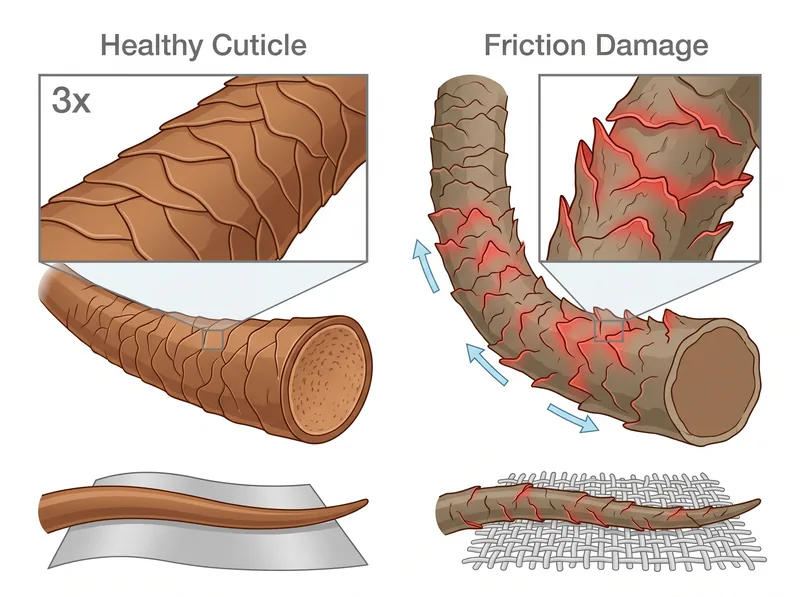 Friction from pillowcases lifts the hair cuticle, creating weak points that lead to breakage
Cotton vs Silk: The Material Science Behind Pillowcase Choice
Cotton pillowcases have a rough, textured surface. Under magnification, you’d see loops and fibers that create friction. Cotton also absorbs moisture, pulling natural oils and hydration products out of your hair overnight. You wake up with dry, tangled hair that’s more prone to breakage when you brush it.
Silk pillowcases are smooth. The tight weave creates a surface your hair can glide across without catching. Silk doesn’t absorb moisture the way cotton does, so your hair retains its natural oils and any leave-in treatments you applied before bed.
But not all silk is equal. Mulberry silk with a momme weight of 19-22 provides the best combination of smoothness and durability. Lower momme weights (below 19) feel thin and won’t last. Charmeuse weave silk has a lustrous side and a matte side; sleep on the lustrous side for maximum slip.
Satin isn’t silk. Satin is a weave pattern, often made from polyester. While satin pillowcases are smoother than cotton, they don’t match silk’s friction reduction. A 2021 study comparing fabric types found that silk reduced hair friction by 43% compared to cotton, while polyester satin only reduced it by 22%.
The cost difference is real. A quality silk pillowcase runs $30-60, while cotton costs $10-15. But consider this: if friction is causing breakage that prevents your hair from reaching your goal length, you’re wasting money on growth treatments that can’t outpace the damage. The pillowcase is a one-time purchase that works every night.
For Gulf residents dealing with hard water damage, the combination matters even more. Mineral deposits make hair brittle. Brittle hair breaks more easily under friction. Switching to silk while addressing water quality with a chelating shampoo like Regrowth+ compounds the protective benefit.
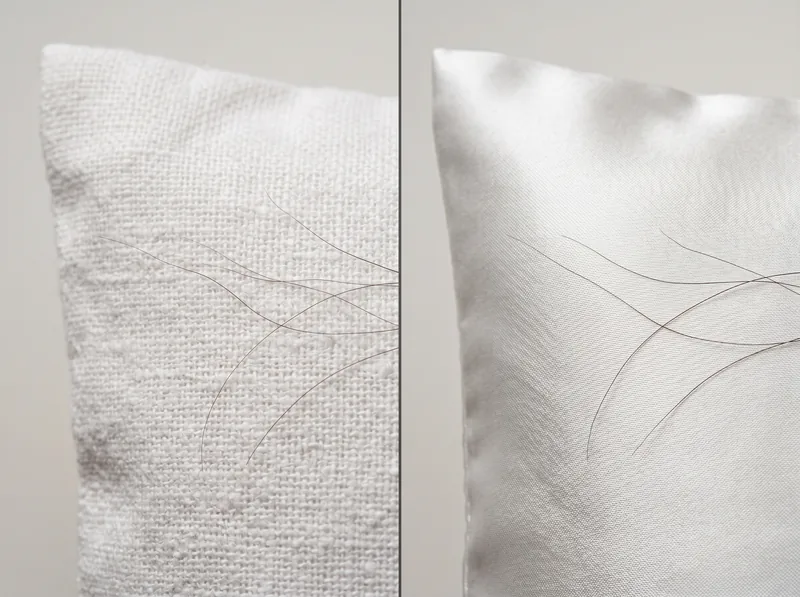 Cotton’s rough weave creates friction; silk’s smooth surface lets hair glide
Sleep Position and Hair Placement: Strategic Adjustments That Work
Side sleepers create a friction hotspot. The hair trapped between your head and the pillow gets compressed and rubbed for hours. If you can’t change your sleep position (most people can’t; it’s neurologically hardwired), you can change where your hair sits.
Move your hair up and over the pillow. Instead of letting it fall between your head and the pillowcase, gather it loosely and position it above your head on the pillow. This eliminates the compression and reduces friction by about 60%. It feels awkward for three nights. Then it becomes automatic.
Back sleepers have it easier. Your hair fans out around your head, distributing contact across a larger surface area. The friction per strand is lower. But you’re not off the hook: the back of your head still creates a friction point, and if you have long hair, the ends are still rubbing.
Stomach sleepers face the worst scenario. Your hair is compressed under your head, and every micro-movement creates friction. If you’re a committed stomach sleeper, hair placement becomes critical. Gather it to one side or use a protective style (we’ll cover this next).
The pillow itself matters. Flat pillows create more surface contact than contoured or lofted pillows. If your head sinks deeply into a soft pillow, more hair surface area contacts fabric. A slightly firmer pillow that maintains some loft reduces contact area.
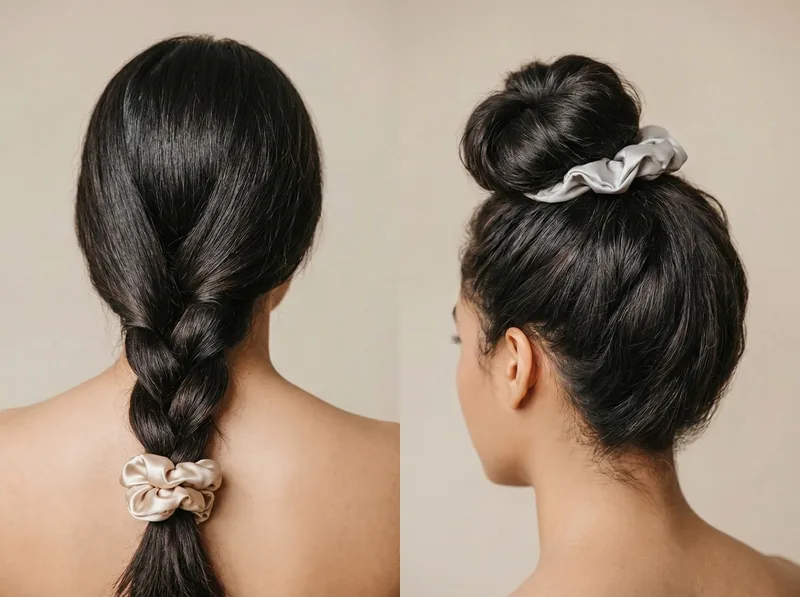 Loose protective styles minimize friction and prevent tangling during sleep
Protective Nighttime Hairstyles: What Works and What Backfires
Tight hairstyles cause traction damage. Pulling your hair into a tight bun or ponytail to ‘protect’ it actually creates stress at the roots and tension along the shaft. Traction alopecia from repeated tension can cause permanent hair loss around the hairline and temples.
Loose is the operative word. A very loose, low braid reduces tangling without creating tension. Use a silk scrunchie or soft fabric hair tie, never an elastic band with metal components. The braid should be so loose you can easily slide your fingers underneath it.
The pineapple method works for curly hair. Gather your hair at the very top of your head in an extremely loose, high ponytail. This keeps curls from getting crushed and maintains curl pattern overnight. Again, use a silk scrunchie with minimal tension.
Bonnets and silk wraps offer full protection. A silk or satin bonnet covers all your hair, eliminating pillowcase friction entirely. This works especially well for textured, curly, or coily hair that’s more prone to tangling. Make sure the bonnet is large enough that it doesn’t compress your hair tightly against your scalp.
What doesn’t work: tight buns, braids with tension, elastic bands, sleeping with wet hair in any style. Wet hair is more elastic and vulnerable. Putting tension on wet hair in a tight style guarantees breakage. If you shower at night, let your hair dry at least 80% before bed, or use a protective loose style.
The Hard Water Connection: Why Gulf Residents See Worse Breakage
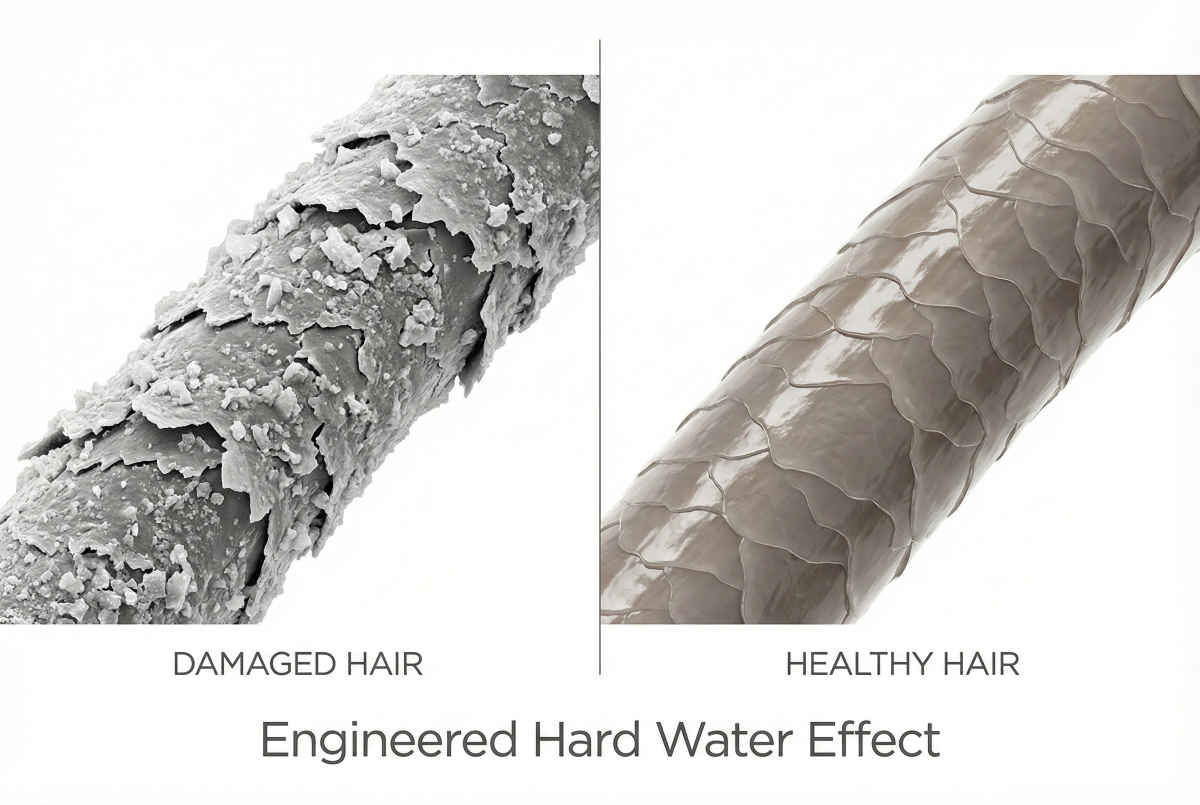
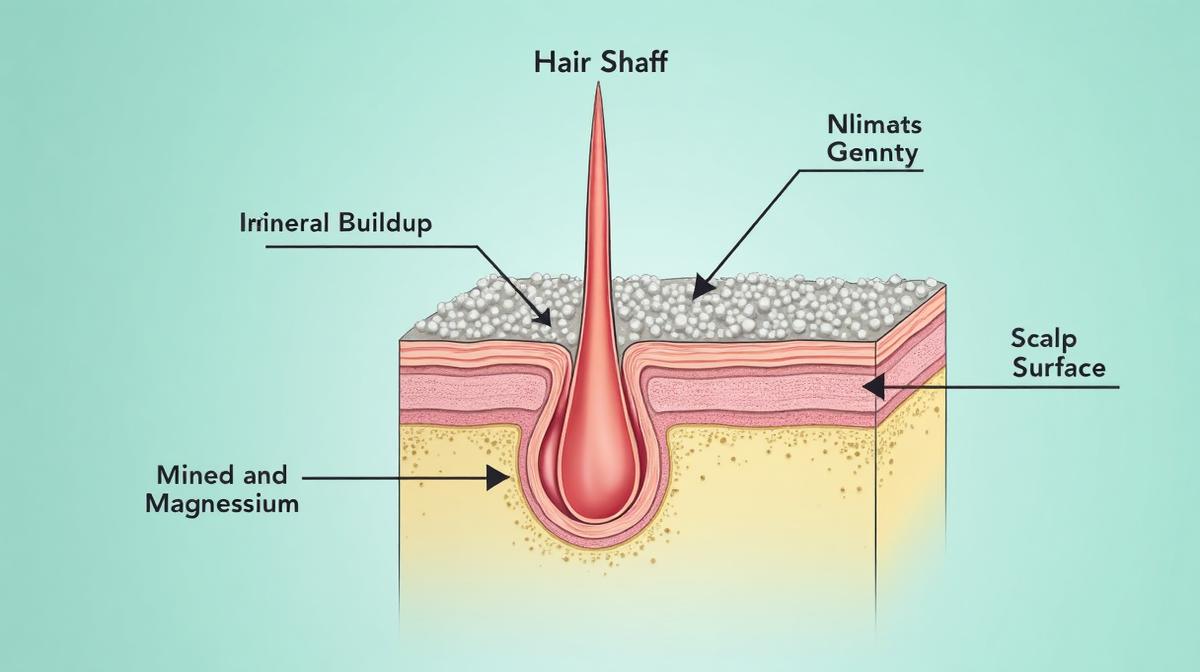
Mineral deposits change hair’s mechanical properties. Calcium and magnesium from hard water bind to the hair shaft, making it rough, brittle, and less elastic. This mineralized hair breaks more easily under any mechanical stress, including friction.
Think of it as a multiplier effect. If friction alone causes X amount of breakage, and mineral damage causes Y amount of brittleness, the combination doesn’t give you X + Y. You get something closer to X × Y. The damage compounds.
A 2020 study in the International Journal of Trichology found that hard water significantly increased hair breakage susceptibility when combined with mechanical stress. Hair samples from hard water areas showed 34% more breakage under controlled friction tests compared to soft water samples.
This is why Gulf residents often notice dramatic shedding and breakage even when using quality products. The environmental factor (hard water) weakens the hair structure, and the behavioral factor (sleep friction) exploits that weakness. You’re fighting on two fronts.
Addressing both levers simultaneously produces better results than tackling either one alone. A chelating shampoo removes the mineral buildup, restoring hair’s natural flexibility and strength. A silk pillowcase eliminates the nightly friction. Together, they give your hair a fighting chance.
Implementation: The First Week Protocol
Start with the pillowcase. Order a mulberry silk pillowcase, 19-22 momme weight, in your pillow size. When it arrives, wash it according to the care instructions (usually cold water, gentle cycle, air dry). Put it on your pillow that night.
Adjust your hair placement. Before bed, gather your hair and position it above your head on the pillow if you’re a side sleeper, or fan it out if you’re a back sleeper. This will feel strange for 2-3 nights. Your brain will adjust.
If you currently tie your hair tightly, buy silk scrunchies. Switch to a very loose, low braid or loose high ponytail. The scrunchie should barely grip your hair. If you see a dent or crease in your hair in the morning, it’s too tight.
Week one, pay attention to morning tangles. If you’re still waking up with matted, tangled hair, your protective style isn’t working. Adjust: make the braid looser, try the pineapple method, or consider a silk bonnet.
Track breakage. Before you start, collect the hair from your brush after your morning routine and estimate the amount. Do this daily for a week to establish a baseline. Then implement the changes and track again after two weeks. You should see a noticeable reduction in short, broken hairs.
References
- Mechanical Friction and Hair Breakage: A Controlled Study - Journal of Cosmetic Science
- Comparative Analysis of Fabric Types on Hair Friction and Damage - ScienceDirect
- Hard Water Effects on Hair Mechanical Properties and Breakage - International Journal of Trichology
- Traction Alopecia: Clinical Features and Management - American Academy of Dermatology